There’s a reason why the term “food porn” exists; food is sexy. Whether it’s the way you eat it or the flavours that excite something within you, the right foods can give your sexual health and wellbeing the boost you need. According to wellness expert Julie Upton, RD, ‘If you want to put some sizzle back into your sex life, food can help you set the mood. There’s nothing better than a romantic, home-cooked dinner, featuring some R-rated foods to help turn up the heat.’ Jennifer R. Berman, MD, the director of the Berman Women’s Wellness Centre, asserts, ‘There’s a growing body of evidence that some of the vitamins and components in foods can enhance sexual function and sexual experience.’ So which frisky foods have modern-day science, as well as aphrodisiac history and lore, to back up their claims?
1. Avocados:Upton details, ‘The Aztecs referred to avocados as, ahem, testicles, because of their physical shape. But the scientific reason why avocados make sense as an aphrodisiac is that they are rich in unsaturated fats and low in saturated fat, making them good for your heart and your arteries. Anything that keeps the heart beating strong helps keep blood flowing to all the right places; in fact, men with underlying heart disease are twice as likely to suffer from erectile dysfunction (ED).’
2. Almonds: ‘Topping my list of feisty foods, almonds have long been purported to increase passion, act as a sexual stimulant, and aid with fertility,’ Upton notes. ‘Like asparagus (another one of my favourite sexy foods), almonds are nutrient-dense and rich in several trace minerals that are important for sexual health and reproduction, such as zinc, selenium, and vitamin E.’ Dr. Berman explains, ‘Zinc helps enhance libido and sexual desire. We don’t really understand the mechanisms behind it, but we know it works.’
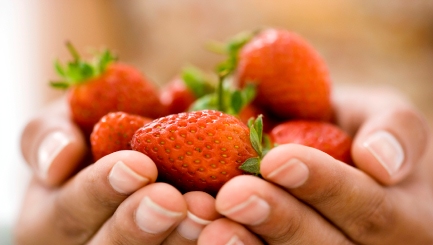
3. Strawberries: ‘The colour red is known to help stoke the fire,’ says Upton. ‘A study found that men find women sexier if they’re wearing red, as opposed to cool colours such as blue or green. Strawberries are also an excellent source of folic acid, a B vitamin that helps ward off birth defects in women and, according to a University of California, Berkley study, may be tied to high sperm counts in men. Try making dark-chocolate-dipped strawberries. And while we’re on the subject, there’s a reason we give chocolate on Valentine’s Day: It’s full of libido-boosting methylxanthines.’
4. Seafood:Upton points out, ‘Despite their slippery and slimy texture, oysters may be the most well-known aphrodisiac. They’re also one of the best sources of libido-boosting zinc. But other types of seafood can also act as aphrodisiacs. Oily fish—like wild salmon and herring—contain omega-3s, which are essential for a healthy heart.’
5. Arugula: ‘Arugula has been heralded as an arousal aid since the first century,’ Upton comments. ‘Today, research reveals that the trace minerals and antioxidants packed into dark, leafy greens are essential for our sexual health because they help block absorption of some of the environmental contaminants thought to negatively impact our libido.’
6. Figs:Upton outlines, ‘These funny-shaped fruits have a long history of being a fertility booster, and they make an excellent aphrodisiac because they are packed with both soluble and insoluble fiber, which is important for heart health. Plus, high-fibre foods help fill you up, not out, so it’s easier to achieve that sexy bottom line—or belly.’
7. Citrus: ‘Any member of this tropical fruit family is super-rich in antioxidants, vitamin C, and folic acid—all of which are essential for men’s reproductive health,’ says Upton. ‘Enjoy a romantic salad that incorporates citrus, like pink grapefruit or mandarin oranges, or use a dressing made with lemon and lime.’