Showing posts with label working from home. Show all posts

Working from home vs. in the office has been a major part of corporate wellness debate recently, as Yahoo revoked its flexible working policy. The memo announcing Yahoo’s change in work policy stated, ‘Speed and quality are often sacrificed when we work from home. To become the absolute best place to work, communication and collaboration will be important, so we need to be working side-by-side. That is why it is critical that we are all present in our offices. Some of the best decisions and insights come from hallway and cafeteria discussions, meeting new people, and impromptu team meetings.’


It seems like a well-thought out plan, but anyone who’s ever worked in a group – or seen an episode of The Apprentice – will tell you that, sometimes, collaborations aren’t possible with different office personalities. Extroverts are often considered to be good workers, as they come across as go-getters with charismatic leadership skills. However, a new study published in the April issue of the Academy of Management Journal has found that these big personalities also tend to be poor listeners an unreceptive to input from others, which can send you running for your home office.


Corinne Bendersky, an associate professor at UCLA’s Anderson School of Management, and Neha Parikh Shah, a professor at Rutgers Business School, completed a series of experiments looking into how extroverts and neurotics worked in various team projects. According to evaluations by team members, the extroverts didn’t fare well. Bendersky explained, ‘The extroverts are probably going to contribute less to the team and the contributions they make will be undervalued by the team. They will do less and what they do will be under-appreciated.’


Neurotics, on the other hand, performed better over time at their jobs. ‘Our intuition about anxious, neurotic employees and colleagues is that their volatility and negativity is going to make them a drag on the team,’ Bendersky noted. ‘What we don’t appreciate is that an aspect of that neurotic personality is really an anxiety of not wanting to disappoint our peers and our colleagues. Neurotics can actually be motivated to work really hard especially in collaborative situations.’


Kellogg School of Management’s Leigh Thompson adds that, yes, you do need to create either physical or virtual spaces in which your workers can collaborate and bounce ideas off each other, but what she calls “caves” are necessary as well. Thompson asserts that a quiet, private spot — perhaps a home office — is needed so that you can truly get down to business without the interruptions of chatty extrovert colleagues.


Office Collaborations: Are Introverts Better Workers?

A corporate wellness policy change made by Marissa Mayer, newly appointed CEO of Yahoo!, has put the work-at-home issue front and centre for many companies. Mayer quashed the option altogether for her employees, with much of the move’s media coverage portraying it a step backwards, but could Mayer have a point?


According to INSEAD Affiliate Professor of Organisational Behaviour, Erin Meyer, ‘I believe the move by Marissa Mayer was a smart one. She saw that productivity per individual at Google GOOG +2.21% was higher than productivity per individual at Yahoo!. Google generates $931,657 in revenue per employee, 170% higher than Yahoo’s $344,758 per employee. If Mayer’s goal is to increase that productivity level, bringing people into the same office space is one quick and inexpensive way to accomplish that goal.’


A memo from Jackie Reses, Yahoo! head of HR, was leaked and this is what sparked off the big debate. The memo explained, ‘To become the absolute best place to work, communication and collaboration will be important, so we need to be working side-by-side. That is why it is critical that we are all present in our offices. Some of the best decisions and insights come from hallway and cafeteria discussions, meeting new people, and impromptu team meetings. Speed and quality are often sacrificed when we work from home. We need to be one Yahoo!, and that starts with physically being together.’


Meyer noted that face-to-face interaction helps companies to reach their objectives more easily. ‘Because we are human beings, when we collaborate, we rely heavily on what I call mutual adjustment,’ she said. ‘Mutual adjustment means that you notice how others are working around you, they notice how you are working, and through hundreds of subtle cues you adjust to one another, and the collaboration happens. When people are geographically dispersed, they don’t have the same high level of cues in order to mutually adjust which makes collaboration more difficult.’


She added, ‘It’s a myth that virtual teamwork costs less than face-to-face collaboration. There is this idea that because it requires less electricity, less desk space, and less rent to collaborate virtually, it’s therefore less expensive.  But it takes a lot more time to organise and monitor effective virtual teamwork.  When we are working together but working apart it requires a much greater effort to assure the communication has passed as expected.   Misunderstandings are more likely and that leads to higher costs.’


Is Working from Home Working Out? The Yahoo! Argument

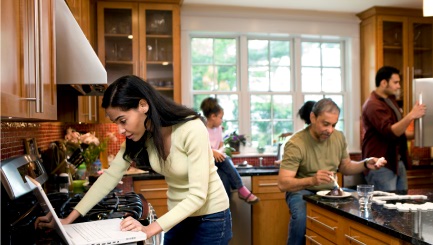
workign from homeAt the recent South by Southwest festival, wellness experts convened to discuss work environments in a talk entitled “Your Desk Job Makes You Fat, Sick and Dead”. This was part of a larger discussion series, aiming to highlight how corporate wellness begins with employee physical, emotional and environmental wellbeing, and this is the incentive that flexible work arrangements, such as working from home, offers.


Moderator Cali Williams Yost, CEO of Work+Life Fit Inc. which is a business that provides consultation and resources for navigating work-life balance, noted that companies such as Yahoo and Best Buy Co are ending location and schedule flexibility for most employees. She said, ‘We could not have planned to have this panel at a better time. Physically and mentally, a lot of us are not doing very well the way we are working currently, and what that does then is it carries into the workplace.’ She continued, ‘We can’t be as creative and innovative and engaged if we aren’t our best physically and emotionally, and that all interacts together to make us and our organisations fat, sick and dead.’


According to Yost, the media tends to cover the extremes of entirely in-office or out-of-office schedules, but a hybrid model, what she refers to as “workshifting,” is a solution that suits many businesses. ‘There needs to be a much more expansive way to think about how, when and where we work, and one way to think about it more expansively is workshifting and really finding the optimal time and place for business and people,’ she said.


Global Workplace Analytics recently showed that 36% of employees would choose increased flexibility over a raise, while a separate study of technology professionals revealed that 37% would even have a 10% pay-cut, if that meant they could work from home. Kate Lister, the president of Global Workplace Analytics, argued, ‘By avoiding the commute just half of the time, a typical employee can gain back 13 days, equivalent work days, that they would have otherwise spent playing in traffic, and they can save between $2,000 and $7,000 per year. Again, this is just half of the time not going to the typical office.’


Leah Brinkmeyer, a Chicago-based marketing executive, attested to the employee-employer benefits of workshifting, ‘The biggest thing is if the company allows for flexibility, then they also have strong values and have high regard for family-work balance. My family is No. 1 in my life, and since they respect that, I find myself bending over backwards for them and being very loyal to them — even if our raises are minimal to none.’


Out of the Office: The Working from Home Debate